
How to pick the right life insurance
plan? Recently, I got quite a bit of inquiry asking about life
insurance. They understand insurance is important in their financial
plans, but they are unsure where to start. so in this article, I want to
write about four simple steps that you can pick the right insurance
plan so you will never have buyer’s remorse
In Canada, there are tons of insurance
choices. First, there’s life insurance, health insurance, disability
insurance, and so much more, and when you look closer at each one,
you’ll soon find out that there are 100 different options for life
insurance
alone with so many variations to choose from. It’s hard to tell what you
really need, and there are more questions you need to answer before you
pick the right insurance.
For example, how much coverage do you
need? Should you go for a term or permanent? How can you know if the
type of insurance is good for you or how much you expect payment? All
the things to consider can make you want to just run away and not pick
any insurance, but to make your life easier, I want to share my 4 easy
filters that help you choose the right insurance.
I have my own 4C methods to choose the
right insurance plan, and it stands for Coverage, Cash flow,
Customization, and Caries. These are the four things you need to
consider when picking the right insurance, and I will explain them in
greater detail now.
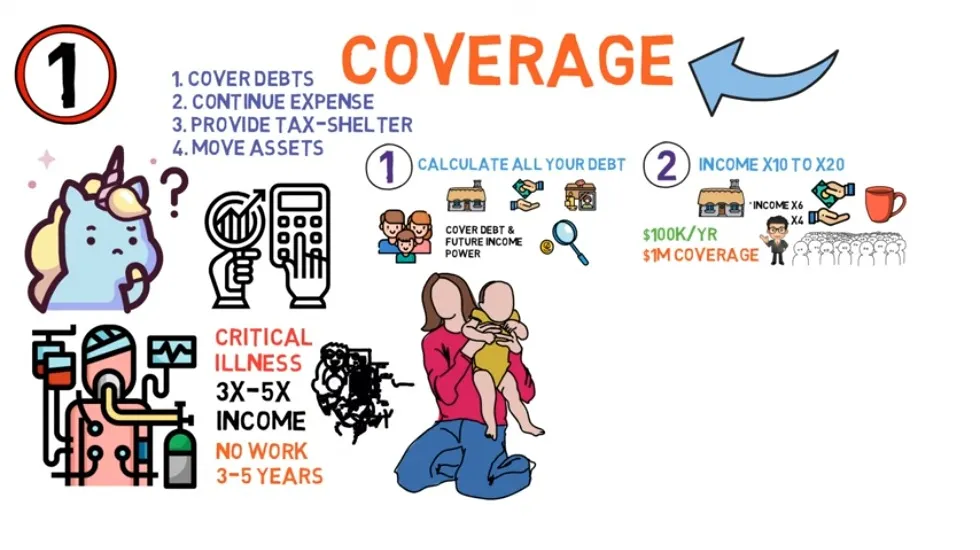
Let’s go to the first c when choosing an
insurance plan. The first question you want to ask yourself is the
purpose of this insurance.
Usually, there are four problems that insurance can help one to cover
debts. Two, to continue the existing lifestyle expense. There, to
provide additional tax shelter vehicles and four, move assets much more
efficiently.
Once we decide what problems to tackle,
we need to ask ourselves what coverage should I get then, and here’s how
I usually calculate the coverage for the insurance needs; when it comes
to life insurance, there are two ways to calculate your coverage.
One, you can calculate all your debt, such as mortgage loan and final
expense, also how much you’d like to provide for your family in case
something happens to you. The right amount of insurance should be enough
to cover the debt and the future income power this way is more
accurate, but there are lots of moving parts, so it might take a longer
time to calculate another way to calculate your needed life insurance
coverage is to take your income and times it by 10 to 20.
The reason behind it because usually,
the mortgage is six times your income already, so the remaining four
times to 10 should be able to cover the other debts. If you make a
hundred thousand dollars a year, then I will recommend at least a
million dollars of life insurance coverage, but again, just like
drinking water is recommended seven to eight glasses per day, but each
individual will be slightly different.
how about health insurance when it comes to sickness, insurance, or what we call the critical illness insurance
I usually recommend three to five times your income. The reason for that
is that you want your insurance to cover as much as possible, imagine.
For example, if you suffer from cancer or a heart attack, there is no
way to return to work soon, so you need to be financially protected for
at least 3 to 5 years without worrying about the money. Still, what if
I’m a housewife with no income? Then I’ll suggest using your husband’s
income as a reference. That’s not a word when you’re sick; your husband
needs to take time off to take care of you, so he needs a plan to
provide financial support.
For sure, we don’t hope that you get so
sick that you cannot work anymore, but that’s exactly what insurance is
for to be protected in case anything happens.

Now I also want to share how you can
calculate the coverage for disability insurance. This one is different
from life and sickness insurance, where if you buy two life insurance,
you can get double the coverage disability insurance is a direct income
replacement insurance.
The maximum you can get is usually
between 65 to 80 of your full income, so that’s a glass ceiling of how
much benefit you can receive. Once the coverage is settled, it’s time to
look at the second C, the Cashflow, which deals with the budget you
should set aside for your insurance. I always recommend using no more
than 10 of the income for all the insurance plans, but my philosophy is
always to use the 10 to cover the remaining 90 of your income and
assets, and here’s what I mean.
Let’s say company A offers you a job for
a hundred thousand, the numbers sound amazing, but they have no benefit
for you that means if you’re sick or disabled, they won’t pay you, or
if you pass away, the company will handle your debts. When you retire,
they have no pension plan for you versus company B, they could offer you
to pay you 90 000 only however they pay you when you’re sick and
disabled, they give you a pension plan when you retire, and also they
will pay your family a lump sum of money if you pass away.
Now what job you’re interested in? So
how do you compare the insurance quotes? There’s a possibility of using
websites to compare different quotes, but keep in mind that those quotes
are just a reference. This gets me to the point why I never recommend
buying insurance strictly online; some people feel drawn to buy
insurance online because it’s fast, and it seems like you can choose
exactly what you need, but what these people don’t understand is that
insurance is not a product it requires a plan. It has many moving parts
as it’s not like buying a house or a car with a set price and a set
return.
Insurance is more complicated than that,
and that’s why it’s so hard for many of us. The next c has to do with
how flexible your insurance is. I recommend looking at points: Do you
want this insurance plan to cover you temporarily or for the entire life
term insurance means that your insurance runs for a set amount of
years. For example, 30 years, your premium is very affordable; however,
once the 30 years is over, the premium
will go up more than 300 percent. Permanence is the opposite. It covers
you for the entire life, but the premium will be higher also; most of
the insurance plan is paid as you go plan as long as you pay, you get
covered. However, some plans can make limited pay, meaning you can pay
the entire permanent plan in 10, 15, or 20 years, like buying a place,
so you know exactly how much you’re paying into this plan. Also, there
are riders meaning you can add different benefits on top. For example,
there are options where you can get all your money back if there’s no
claim involved or if you’re on disability, then you don’t have to pay
the premium. There are at least 30 riders that you can choose from, and
there’s a lot to consider. this is very different from caries to
curious, and it can be a bit confusing because it’s not always
transparent, which gets us to the last C when choosing insurance
It also matters which company or carrier
you pick because different companies focus on different things; for
example, some companies focus on doing whole life insurance, and they
give a better dividend, some focus on term insurance, and some focus on
the professional markets like doctors or dentists and some focus on
family or young individuals and lastly some might focus on rejected
cases even you get declined by other insurance companies before some can
provide guaranteed acceptance which is quite unique in the market.
so when you choose any insurance plan, remember the 4C coverage
cash flow
customization and
caries
Remember, insurance is a solution, not a
product and I suggest at least talking to a professional first because
for the coverage and cash flow, you can find it out on your own, but for
customization and carrier, you need an advisor’s help.
created with
Website Builder Software .